Avascular Necrosis of the Hip (AVN): Causes, Staging & Treatment
Medically reviewed by Dr. Neelabh, MS (Orthopedics) Educational information only—always consult a qualified Orthopedic specialist for diagnosis and treatment.
Avascular necrosis of the hip (also called osteonecrosis) occurs when the blood supply to the femoral head (the “ball” of the hip) is disrupted, leading to bone cell death. Without treatment, the weakened bone can collapse, causing severe pain, stiffness, and arthritis.
On this page
What is AVN of the Hip?
The hip is a ball-and-socket joint. In avascular necrosis of the hip, the femoral head (the ball) loses its blood supply and the bone tissue dies. In early stages, X-rays may appear normal, but as the bone structure weakens, it can begin to collapse. This deforms the smooth joint surface, leading to painful arthritis. It is common for AVN to affect both hips.
Causes & Risk Factors
- Corticosteroid Use: Often related to high doses or prolonged use.
- Excessive Alcohol Intake: A major non-traumatic risk factor.
- Trauma: Hip dislocations or femoral neck fractures can damage blood vessels.
- Medical Conditions: Sickle cell disease, lupus, blood clotting disorders, and organ transplants are known associations.
- Other Factors: Radiation therapy, decompression sickness (“the bends”).
- Idiopathic: In a significant number of cases, no clear cause can be identified.
Symptoms
- Groin Pain: This is the most common initial symptom, sometimes radiating to the buttock or thigh.
- Pain with Weight-Bearing: Pain that worsens when walking or standing.
- Pain at Rest: As the condition progresses, pain can occur even at night.
- Stiffness & Limp: Reduced hip motion and a noticeable limp are common.
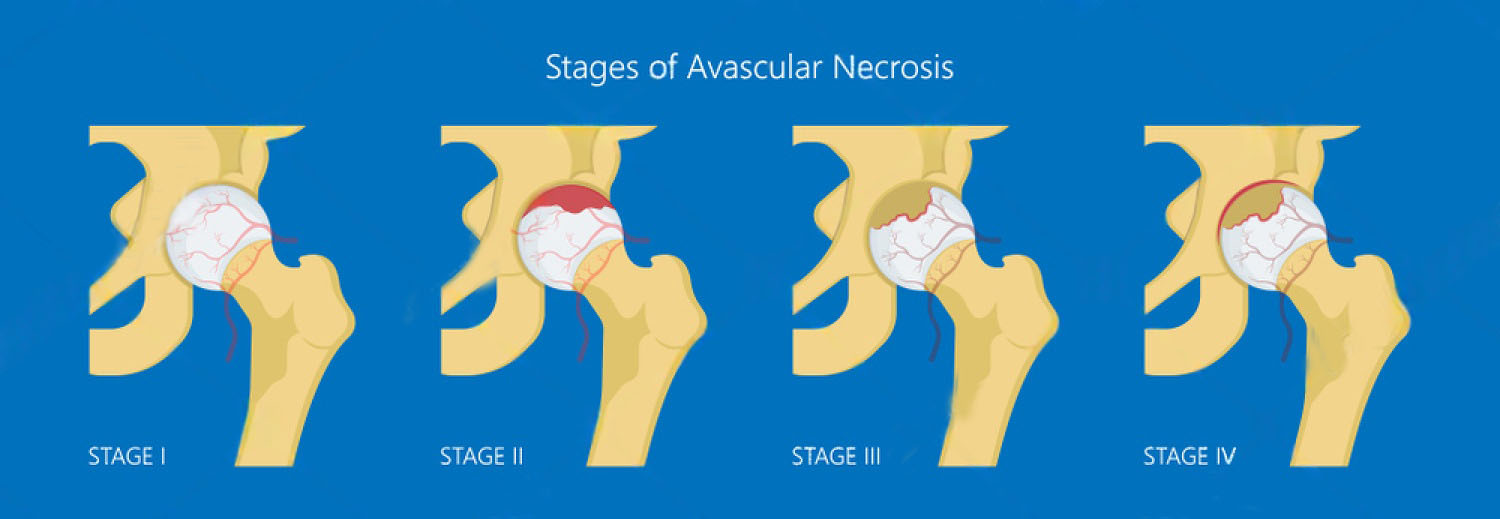
Avascular Necrosis of the Hip: Diagnosis & Staging (Ficat/ARCO)
An accurate diagnosis and staging are crucial for determining the best treatment plan.
- Physical Exam: We assess your gait, range of motion, and pain with specific hip movements.
- X-rays: May be normal in early stages but can show bone changes (sclerosis, cysts) or collapse later.
- MRI: This is the most sensitive imaging test, capable of detecting avascular necrosis of the hip long before it is visible on an X-ray.
- Screen both hips: AVN is often bilateral—your surgeon may recommend MRI of the opposite hip.
| Stage (Simplified) | Description | Typical Treatment Goal |
|---|---|---|
| Stage I–II | Pre-collapse. MRI shows AVN, but the femoral head is still round. | Joint Preservation |
| Stage III | Early collapse. A “crescent sign” or flattening appears on X-ray/MRI. | Preservation (select cases) or Replacement |
| Stage IV | Advanced collapse with secondary arthritis. | Joint Replacement |
Treatment by Stage
Stage I–II (Pre-Collapse): Joint-Preserving Options
In early stages, the goal is to save the natural hip joint.
- Risk-Factor Modification: Modifying steroid use (if medically possible), stopping alcohol, stopping smoking, and managing underlying conditions (lipids/coagulation, autoimmune, etc.).
- Core Decompression: One or more channels drilled into the femoral head to relieve pressure and encourage new blood flow. Most effective in early-stage avascular necrosis of the hip with smaller lesions; often combined with bone grafting or biologic agents.
- Bone Grafting: Using the patient’s own bone (autograft) or donor bone (allograft) to provide structural support. Vascularized grafts, like a free fibular graft, are complex but effective options for select young patients.
Stage III–IV (Post-Collapse): Joint Replacement
Once the femoral head has collapsed and arthritis has set in, joint replacement is the most reliable way to eliminate pain and restore function.
- Total Hip Replacement (THR): This procedure replaces the damaged ball and socket with durable artificial components. Modern Total Hip Replacement provides excellent long-term outcomes for patients with avascular necrosis of the hip.
A Surgeon’s Perspective by Dr. Neelabh
“For young patients with AVN, my priority is always to explore every viable joint-preserving option first. Procedures like core decompression with bone grafting can be very effective in the early stages. However, once the hip has collapsed, a Total Hip Replacement is the most predictable path back to a pain-free, active life. We make this decision together, based on your specific stage, symptoms, and lifestyle goals.”
What to Expect at Your Consultation
- Detailed Discussion: A thorough review of your symptoms, risk factors, and what you hope to achieve.
- Physical Examination: A comprehensive assessment of your hip’s range of motion, strength, and gait.
- Imaging Review: We will review your X-rays and MRI with you, explaining the stage and extent of avascular necrosis of the hip.
- Personalized Treatment Plan: You will receive a clear diagnosis and a customized treatment plan, discussing all appropriate options from joint preservation to replacement.
Frequently Asked Questions
Is hip replacement the only solution for AVN?
No. In early stages (pre-collapse), joint-preserving procedures like core decompression and bone grafting can be successful options for select patients. Hip replacement is the definitive treatment once the bone has collapsed and arthritis develops.
Does core decompression surgery actually work?
Yes, it can be effective, especially for early-stage avascular necrosis of the hip with smaller lesions. Its goal is to prevent collapse. Success rates vary based on the stage and technique, but it is a valuable tool in the joint preservation toolkit.
Are “stem cells” a guaranteed cure for AVN?
No. While biologics like stem cells are sometimes used to augment core decompression, evidence is still evolving, and they are not a standalone cure. Be cautious of treatments that promise guaranteed results.
Can both hips be affected?
Yes. Avascular necrosis of the hip is frequently bilateral. Your surgeon may recommend imaging of the opposite hip—even if symptoms are one‑sided—to detect early disease.
Need an Expert Opinion?
We use a conservative-first approach and offer both joint-preserving and replacement options, tailored to your stage and goals. Explore our Orthopedic services or book a consultation.
Further Reading: AAOS OrthoInfo: Osteonecrosis of the Hip · NHS: Avascular Necrosis